How to Learn a Language with Podcasts (Even When You're Busy)
If there's one thing we know about language learning, it's that it takes time. And for many adults, finding that time is the real challenge. Podcasts fix part of the problem, but simply pressing play isn't the same as learning. This guide shows you how to learn a language with podcasts: how to choose one, when to listen passively and when to focus, and how to turn what you hear into vocabulary you know.
Podcasts are popular with language learners for one simple reason: they fit into a life that's already busy. You can listen while commuting, cooking dinner or making your morning coffee, turning time that's already spoken for into contact with the language you're learning.
The question is how best to use podcasts to develop your language skills. That's what this guide answers. Along the way we'll show where TroveReader helps: checking meanings as you listen, saving words and phrases for later, and seeing your progress as you move words from Learning to Known.
1. Choose a Podcast You Can Mostly Follow
Podcasts for language learning fall into three broad groups:
- Learner podcasts. Made for people studying the language, with slower speech, clearer pronunciation and simpler vocabulary. They're a comfortable place to start: a few hundred words is enough to begin with most learner-focused shows.
- Native podcasts. Made for native speakers, covering everything from news and comedy to history and sports. The language is fast and unfiltered, and it's the real thing.
- Bilingual podcasts. These mix your target language with English explanations, and often focus on explicit grammar teaching.
A simple level test: if you can follow the general flow of an episode without understanding everything, the level is about right. If you're completely lost, it's probably too difficult. You can add a transcript for support or switch to something easier, and neither choice is a step backwards. If it's so easy that you get bored, it is likely not challenging enough for you. The best podcast is one you keep listening to, and when in doubt, go with what you find enjoyable.
If you're learning Spanish, we've already done the sorting: the best Spanish learning podcasts ranks learner-friendly shows by level and dialect, from slow beginner series up to native-speed conversations.
2. Use Three Modes of Listening
Switching on a podcast doesn't need to feel like a study session. Think of listening as a spectrum with three modes, with a place for each in your learning:
| Mode | Best for | What you do |
|---|---|---|
| Passive | Chores, commutes, exercise | Let the language wash over you, without pausing |
| Semi-active | Walking, cooking | Recognizing phrases, hearing recurring topics, catching the gist |
| Active | Focused study | Using a transcript, look-ups, saving and reviewing vocabulary |
Passive listening: background exposure
Think of passive listening as exposure, not your main study method. It keeps the language present in your day and gives you extra contact with its sounds and rhythm, but hearing a language isn't the same as learning it. When you have the attention to spare, focused listening is what gives you opportunities to notice, understand and start to retrieve new language. Passive listening works best on episodes you've already studied actively: hearing familiar phrases again keeps them fresh without costing you effort.
Semi-active listening: catching chunks
When you're walking, cooking or doing something that only half occupies your mind, you can afford to listen a little more closely. Pick out familiar words and phrases, and notice the topics that come up again and again. You might catch yourself imitating a formulaic introduction you've heard a few times. Semi-active listening is ideal as a first listen: get the gist now, then return to the difficult parts later.
Active listening: giving it your full focus
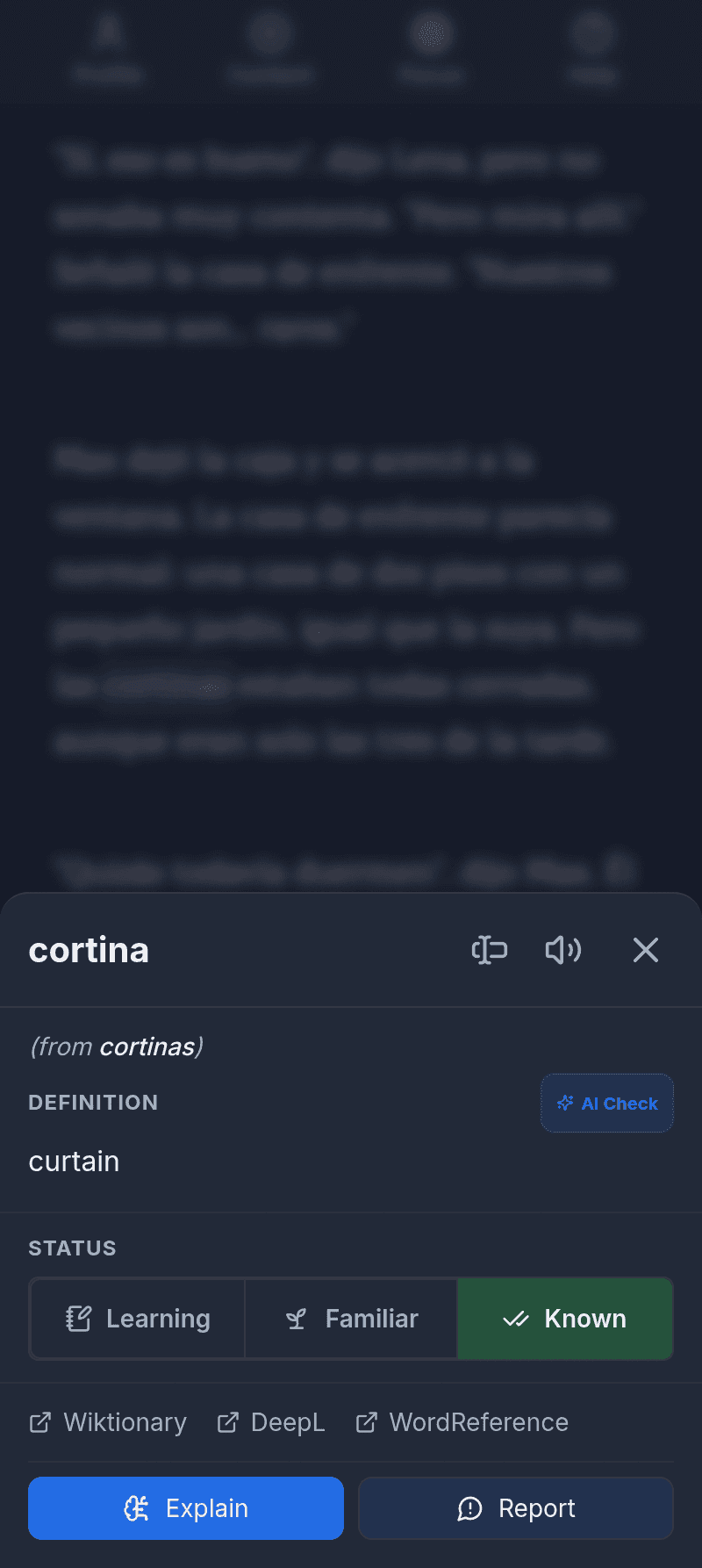
This is the mode that produces real comprehension. Sit down with one episode and give it your attention. If you're using TroveReader, load the transcript alongside the audio. Click any word you're unsure of and TroveReader pauses the audio while you check the meaning, and you can add it to your word list if it looks useful. If the transcript has timestamps, the audio and text will also automatically sync. Even a few minutes of focused listening is often more valuable than simply a longer stretch of background audio.
There's a time and place for all three. Passive listening keeps you in daily contact with the language; active sessions turn that contact into understanding.
3. Listen for Meaning, Not Every Word
When you start listening in your new language, it's tempting to try to catch every word. Don't. In real conversation, words rarely arrive as neat, isolated units: they run together, get shortened and blur into a continuous stream of sound. Chasing individual words is a losing game.
Aim instead for chunks: common phrases and groups of words, plus the main idea. Can you say what the topic is, who's speaking, and what their point is? That's comprehension. Learning to hear in phrases rather than isolated words is one of the biggest steps to understanding speech at natural speed.
4. Use Transcripts When Your Ears Get Stuck
Everyone has words they know on paper but can't catch in speech. You recognize the written word, you know what it means, yet at natural speed it slips past you. Connected speech changes how words sound and where one ends and the next begins, and that gap between the eye and the ear is exactly what a transcript closes. Reading along while you listen connects the sound back to a written form you already know. Research on captioned second-language media points the same way: captions have been found to help vocabulary learning, though the gains fade over time without further practice, which is where saving and revisiting come in (more on both below).
Portuguese is a good example: situação, informação and educação look instantly familiar to an English speaker, but their natural pronunciation can make them much harder to recognize by ear. Once you notice the pattern (English -tion has equivalents in many languages), one insight unlocks hundreds of words.
Transcripts also let you:
- Confirm what you heard against what was actually said
- See how words are spelled and where sentence boundaries fall
- Bridge into harder content: read along first, then listen without the text
A word of caution on easy-looking matches: some similar-looking words are false friends. Spanish embarazada means “pregnant”, not “embarrassed”. A transcript, plus a quick lookup, catches these before they stick.
This is where having audio and transcript side by side earns its keep: you can check what you heard without leaving the episode. And if a podcast doesn't publish transcripts at all, TroveReader Premium can generate one for you, so the method isn't limited to shows that happen to come with one.
5. Save Useful Phrases, Not Just Words
Textbooks teach correct language. Podcasts teach living language: the phrases native speakers actually use. Listen for:
- Idioms, slang and expressions you won't usually find in a textbook
- Phrases that recur: ways of agreeing, hesitating, joking and changing the subject
- Real pronunciation: words that run together, sounds that get dropped, the gap between how a word looks and how it sounds at speed
When you hear an expression you'll use again, save the whole phrase rather than just the unfamiliar word. Idioms rarely survive being taken apart. TroveReader lets you look up and save whole phrases along with the sentence you heard them in, so you get the context back when you review.
This is also where cultural immersion comes in. Podcasts show you how people joke, what they reference without explanation, and what they find funny or frustrating, the things a vocabulary list can't teach.
6. Build a 15-Minute Daily Routine
Consistency matters more than intensity: fifteen minutes a day beats a three-hour session once a month. Here's a routine that fits into a lunch break, using TroveReader:
- Minutes 1–5: Listen for the gist. Play an episode without pausing. Don't chase individual words; just work out what's happening.
- Minutes 6–10: Listen with the transcript. Replay and read along. Look up only the words that genuinely block understanding.
- Minutes 11–12: Save useful language. Save three to five words or phrases you think you'll actually use again.
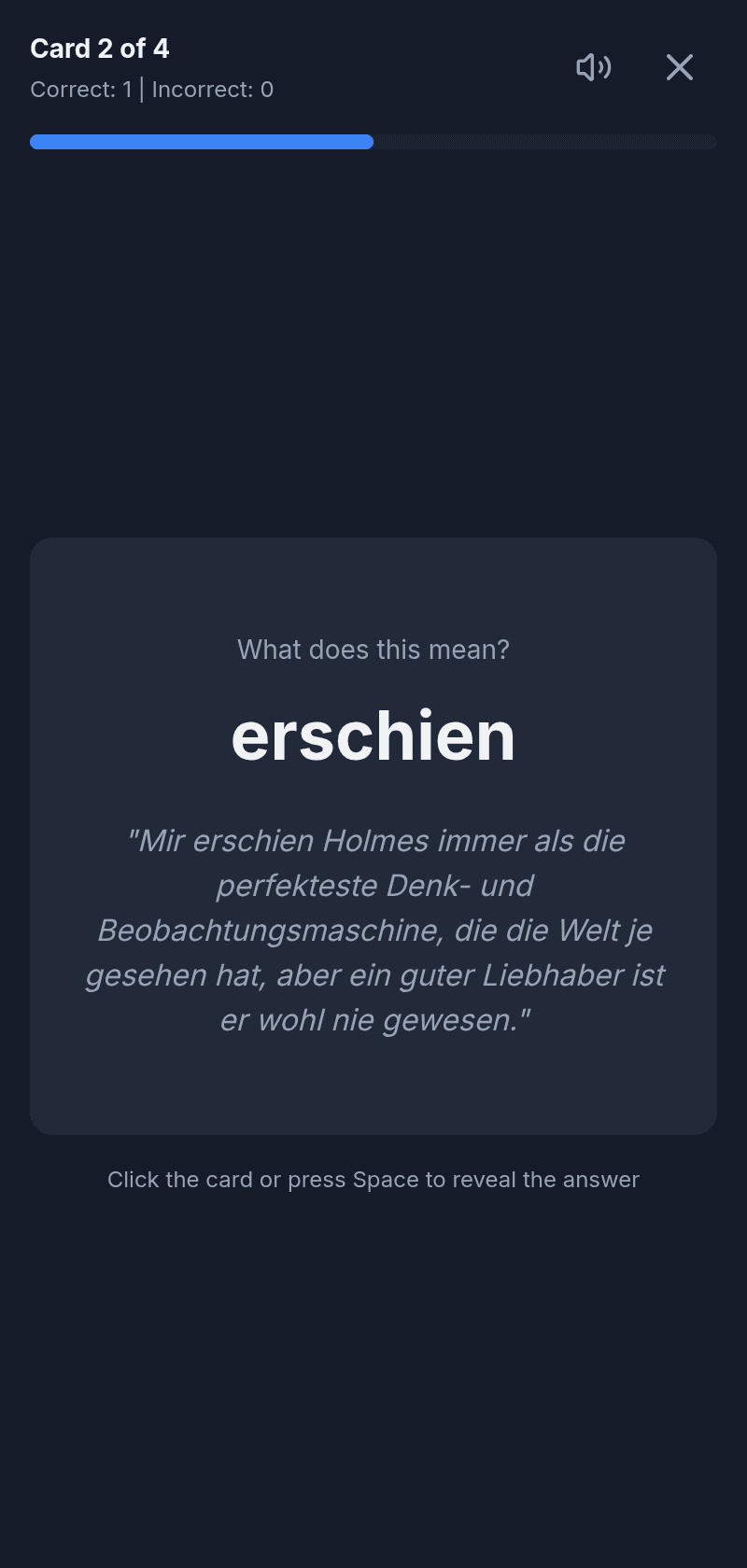
- Minutes 13–15: Review. At the end of the podcast, use our integrated flashcard player to review words you saved from this transcript or from previous days. Over a few weeks, you'll move saved words from Learning to Known, and seeing that progress is a real motivator.
Then tomorrow, listen to the same section again: passively, on your walk or while the coffee brews. Repetition is what moves a phrase from heard to known.
7. Revisit Instead of Always Starting Something New
Podcasts are unusually well suited to revisiting:
- Vocabulary recurs. Stick with one show and you'll meet the same words and phrases across episodes, which helps them stick far better than seeing them once.
- You get to know the hosts. After a few episodes, their voices, humor and running jokes become familiar, which makes it easier to keep coming back.
- It fits your routine. Attach listening to something you already do every day, like your commute or your morning coffee.
Don't just listen and move on. Listening builds vocabulary in context, but how much you pick up from any single exposure is limited; revisiting is where it consolidates. And when you revisit, retrieval beats re-reading: research on vocabulary learning has found that trying to recall a word, and spacing those attempts out, can work better than seeing it again passively. In TroveReader, saved items keep the sentence you met them in and are highlighted wherever they reappear, so yesterday's episode quietly revises itself in today's. The built-in flashcards then ask you to recall the word, not just recognize it.
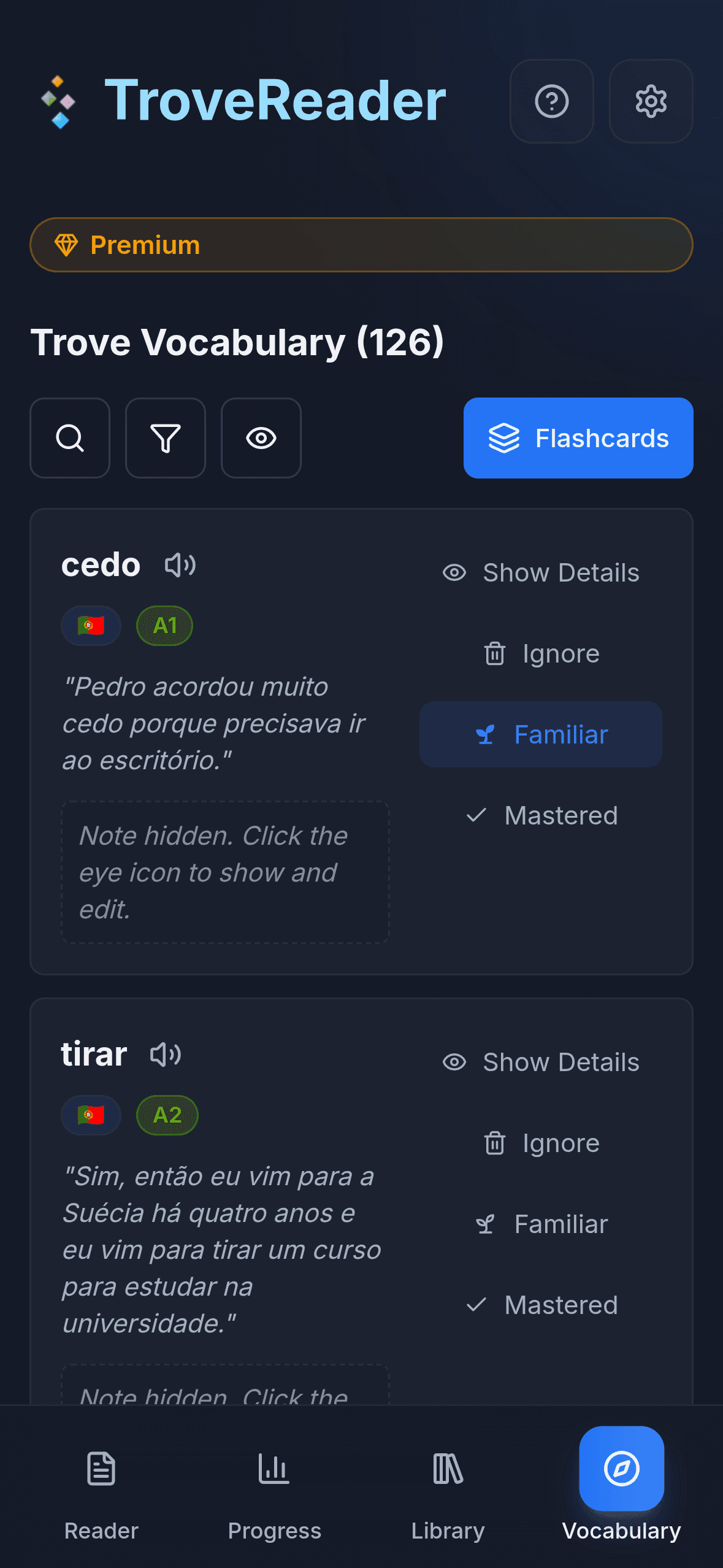
TroveReader also shows you how far you've come. Every word you save sits in one of three categories, Learning, Familiar or Known, and you will move it up as you get to know it. It helps you track what you've read and the podcasts you've listened to, so a habit that can feel invisible day to day becomes something you can see building over weeks.
From Exposure to Active Learning: How TroveReader Fits In
Podcasts give you authentic language, but on their own they leave questions you can't answer in the moment: What did that phrase mean? Was that a word I've seen before? Learning happens in stages, and a podcast on its own only covers the first:
| Stage | What you're doing | What helps |
|---|---|---|
| Exposure | Hearing the language | Any podcast; it's where everyone starts |
| Noticing | Connecting sounds with written words | The transcript, side by side with the audio |
| Understanding | Resolving words you don't know | Click to look up; the audio pauses while you check |
| Saving | Saving useful language for later | Keep words and phrases along with the context you saw them in |
| Retention | Recalling them later | Flashcard review; saved words resurface highlighted |
| Production | Speaking out loud | Repeating phrases you hear until they feel natural |
Podcasts alone get you exposure to the language you are learning. TroveReader exists to help you get more from that time: using the transcript for noticing, click-to-look-up for understanding, saving words with their context, and review for building long-term retention. Your saved words, explanations and context sentences can be exported as a CSV file to import into Anki or use in whatever tool you prefer, and our built-in flashcards ask you to recall what you saved, in the context you met it in, rather than as an isolated word.
TroveReader supports Spanish, French, German, Italian and Portuguese. Core reading and listening features are free, with no credit card required. Premium ($5/month) adds transcription and other tools, and covers all supported languages.
Quick Recap: Getting Started Today
- Pick one podcast you can mostly follow, and stick with it for a few weeks.
- Mix your modes: passive in the background, semi-active on the move, active when you can focus.
- Listen for chunks and the main idea, not every word.
- When your ears get stuck, check the transcript.
- Save whole phrases you'll use again, with their context.
- Fifteen minutes a day, ending with a quick review of words you saved from today or previous days.
FAQ: Learning a Language with Podcasts
Can you learn a language just by listening to podcasts?
Podcasts are a great source of listening exposure, but listening alone won't build every skill. You'll progress fastest when you combine it with focused listening, vocabulary review and some speaking practice. Podcasts fit that routine well precisely because they make daily contact with the language easy.
Is passive listening useful for language learning?
Yes, as exposure rather than a substitute for study. It keeps the language present in your day and tunes your ear to its rhythm, and it works especially well when re-listening to episodes you've already studied actively. Use it to increase contact with the language; use focused sessions to turn that exposure into learning.
How long should I listen each day?
Consistency matters more than duration. Fifteen to twenty minutes a day of engaged listening beats a long weekly session. The 15-minute routine above is a good template.
Do I need transcripts to learn from podcasts?
No, but they help a lot. Reading along while you listen makes it easier to catch words you'd otherwise miss, and to check a meaning without losing your place. Most learner podcasts publish transcripts, and for those that don't, TroveReader Premium can generate one.
How do I know if my listening is working?
TroveReader helps with this. You can see the list of words you have saved, and over time you will move them from Learning to Familiar to Known. We also help you track how much you have read and which podcasts you have already listened to.
The Research Behind This Guide
The advice in this article draws on research into how people learn language from listening, captions and review. If you want to go deeper:
- Investigating Textual Enhancement and Captions in L2 Grammar and Vocabulary (Cintrón-Valentín & García-Amaya, 2021, Studies in Second Language Acquisition): captioned video produced strong immediate gains in vocabulary learning, though most gains faded without further practice.
- The Advantages of Retrieval-Based and Spaced Practice (2020, Language, Speech & Hearing Services in Schools): a review of why testing yourself and spacing out reviews beats passive restudy for word learning.
- Retrieval practice and context dependence in digital flashcard vocabulary learning (2025, Behavioral Sciences): retrieval practice with digital flashcards outperformed restudying, and the benefit grew with more rounds of practice.
We summarize the learning principles behind TroveReader's design in our research overview.
Learn from Podcasts You Already Enjoy
Listen, read along, check what you missed, and build vocabulary that sticks, from the shows you were going to hear anyway. Free to start.
By TroveReader · Updated October 2026